
December 2025
Introduction
Receiving a subpoena can be unsettling for a doctor or practice manager, particularly when it seeks confidential patient information or requires a practitioner to attend court during consulting hours. However, a subpoena is not simply a request from a solicitor. It is a formal court process and must be addressed promptly. The correct response requires balancing legal obligations, patient confidentiality, clinical record integrity and the reasonable costs of compliance. This article focuses principally on medical practices in New South Wales, while identifying important differences in federal and family law proceedings. The relevant court rules and the wording of the particular subpoena must always be checked.
What is a subpoena?
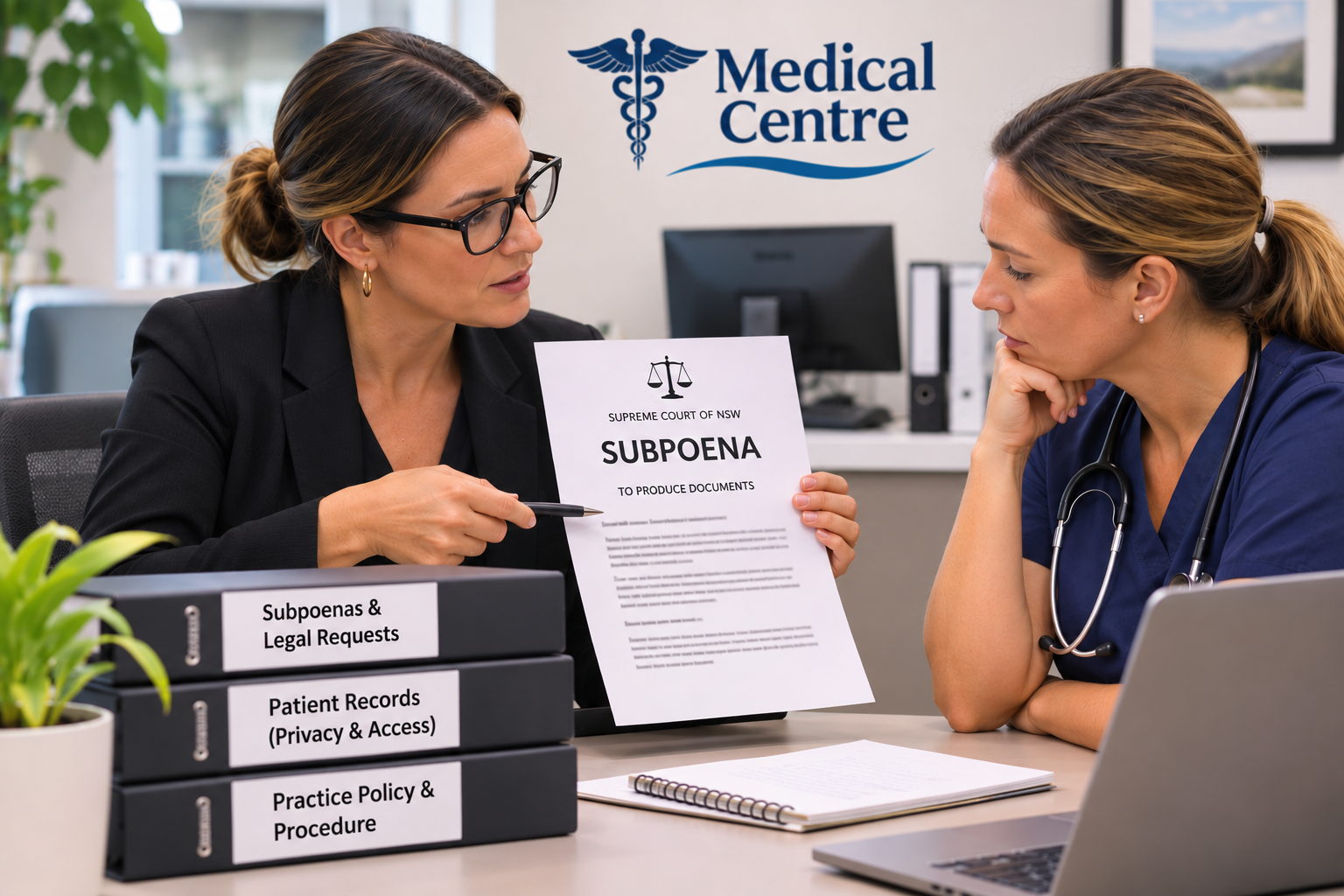
A subpoena is an order requiring its addressee to produce specified documents or things, attend court to give evidence, or do both. A subpoena to produce may require clinical notes, referrals, pathology results, correspondence, appointment records or billing records within the practice’s possession, custody or control. A subpoena to give evidence may require the treating doctor to answer questions under oath or affirmation. Some documents that look similar, including a solicitor’s request for records, a patient authority, a notice to produce and a search warrant, have different legal effects. Staff should never assume that a letter headed “urgent” has the force of a court order.
First steps when a subpoena arrives
Immediately record the date and method of receipt, the court and proceeding number, the addressee, the last date for service, the return date and precisely what has been requested. Send the document to the practice manager or nominated senior person and, where necessary, obtain legal advice. Identify which entity actually holds the records: the doctor, a service entity, a corporate practice or another custodian. Check whether the subpoena is directed to the correct person or organisation. Preserve potentially relevant records and suspend routine deletion or alteration processes affecting them. Allocate responsibility for locating, reviewing and securely delivering the material, allowing time for objections and any court directions. Do not leave the task until the return date.
Is the subpoena validly served?
The requirements for issuing and serving subpoenas depend on the court and type of proceeding. Under Part 33 of the NSW Uniform Civil Procedure Rules 2005, personal service is the general rule, but actual knowledge and other provisions can affect compliance and enforcement. The Federal Court also generally requires personal service under its subpoena rules. In family law proceedings, the Federal Circuit and Family Court of Australia distinguishes between subpoenas to give evidence, which require personal service, and production-only subpoenas, which may be served by ordinary or agreed service. Electronic delivery is therefore not automatically invalid or automatically sufficient: examine the applicable rules, any court order and any agreement about service. Likewise, a court seal or electronic authentication should be assessed in the context of the court’s current issuing arrangements. If there is a defect, seek advice rather than simply ignoring the document.
Time limits and extensions
A subpoena normally identifies both a last date for service and a date for attendance or production. The permissible interval and consequences of late service differ across jurisdictions. A practice receiving a subpoena with an unrealistic deadline should promptly contact the issuing solicitor to request an extension, preferably confirmed in writing, and seek a formal variation or court direction where necessary. An informal agreement with a solicitor does not necessarily change an existing court order. Where extensive archived records, multiple practitioners or sensitive material are involved, explain the work required and propose a realistic timetable before the deadline expires.
Patient confidentiality and privacy
Medical records contain sensitive health information, but confidentiality does not ordinarily permit a practice to disregard a lawful subpoena. Disclosure compelled or authorised by law may be permitted under applicable privacy legislation, including the Privacy Act 1988 (Cth) and NSW health privacy laws where relevant. Nevertheless, the practice should disclose only what the order lawfully requires, through the specified court process. A subpoena is not a general authority to hand the patient’s entire file directly to the opposing solicitor. In many proceedings, documents are produced to the court, which controls inspection and access. The fact that material has been produced does not necessarily mean every litigant can immediately inspect it. Patient notification should be considered in light of the applicable law, court directions, confidentiality concerns and any risk of prejudice; it is not a universal prerequisite to compliance.
Sensitive records and objections
Particular care is required with mental health records, sexual assault counselling communications, children’s records, third-party information and material that may attract legal professional privilege or another statutory protection. Family law legislation also contains specific protections relating to certain confidential professional communications. A practice should identify potentially protected material early and obtain advice about whether to object, request restricted access or seek an order setting aside or narrowing the subpoena. Common grounds for challenge may include irrelevance, excessive breadth, oppression, improper purpose, privilege and applicable statutory protections. An objection must be raised using the correct procedure and within the relevant timeframe. A practice should not unilaterally redact or withhold responsive material merely because it considers it embarrassing or confidential.
What records should be produced?
Read the schedule carefully. Determine the patient, date range, document categories and any exclusions. Search relevant clinical software, scanned correspondence, attachments, archived files and other repositories reasonably within the addressee’s control. Electronic records may include audit trails, messages, uploaded documents and metadata if those categories are properly requested. Do not alter clinical entries, retrospectively rewrite notes or remove inconvenient material. Where a record needs an explanatory correction, follow the ordinary clinical amendment process, preserving the original and audit history. Avoid creating a new narrative report unless the subpoena requires one or separate instructions are properly agreed. Keep a clear record of the search undertaken, the documents copied and the date and method of production.
Producing records securely
Follow the court’s directions for electronic or physical production. Some courts accept approved electronic filing or secure transmission, while others require particular formats, envelopes, schedules or accompanying forms. Use encrypted or otherwise approved secure methods for sensitive records, verify the recipient and avoid ordinary unsecured email unless the court’s process permits it and the risks are managed. Label the proceeding accurately and retain evidence of delivery. If the practice produces original documents or physical items, confirm how they will be held and returned. Where only copies are required, retain the source records in accordance with the practice’s retention obligations.
Conduct money and witness fees
Conduct money is intended to meet the reasonable expenses associated with complying with a subpoena, but its meaning, minimum amount and timing vary between courts and subpoena types. In NSW civil proceedings, the rules distinguish attendance requirements and the tender of conduct money; practices should not assume that every production-only subpoena must be accompanied by the same fixed amount. Federal Court rules provide that an addressee need not comply where conduct money has not been tendered a reasonable time before the specified attendance or production. In federal family law proceedings, specific conduct money and witness-fee provisions apply, including published minimums. The practice should check the governing rules and avoid relying on a universal fee or an assumption that conduct money fully compensates the practitioner for time away from consulting.
Recovering reasonable compliance expenses
Searching, retrieving, reviewing, copying and transmitting records may consume substantial administrative and professional time. Non-party recipients may be able to seek payment of reasonable loss or expense in addition to conduct money, subject to the applicable court rules and any order. In appropriate cases, recoverable expenses can include reasonable legal costs. This is not necessarily an automatic right to invoice a solicitor for any amount the practice chooses. Before incurring significant costs, notify the issuing party promptly, provide a sensible itemised estimate and seek agreement or directions. Keep time records, invoices and evidence of necessary work. If agreement cannot be reached, the court may determine the appropriate amount. Whether GST applies to a particular charge depends on the nature of the supply and should be assessed separately.
Attendance at court and cancelled appearances
A subpoena to give evidence can interrupt appointments and create significant lost income. Confirm whether personal attendance is required, whether remote attendance is available and whether the practitioner can be released or placed on standby. Never assume a phone call from one solicitor cancels a court obligation; obtain reliable written confirmation of withdrawal, release or a court direction. Witness allowances, professional fees and compensation for wasted attendance or late cancellation depend on the jurisdiction, applicable rules and any agreement or order. There is no general Australia-wide entitlement to a “standby fee” whenever a subpoena is cancelled within 14 days.
When compliance is difficult or impossible
A practice may not hold the requested records, may have transferred them lawfully to another custodian, or may face an unreasonable or technically impossible demand. Explain the issue promptly to the issuing party and, if required, to the court. Do not claim that records do not exist without a reasonable search. Where the subpoena seeks documents held by another independent organisation, distinguish those records from information actually within the practice’s control. If the practice wishes to challenge the subpoena, follow the court’s objection or set-aside procedure. Ignoring a subpoena without lawful excuse can result in serious consequences, including contempt proceedings and costs orders.
A practical practice protocol
Every practice should have a written subpoena procedure and a designated responsible officer. Reception staff should know how to identify and escalate legal documents without discussing patient information with a process server. The protocol should include deadline tracking, identity and authority checks, a secure records search, legal review of sensitive categories, a process for cost estimates, court-compliant production and a confidential register of subpoenas received. Staff should be trained not to send records directly to lawyers merely because a subpoena has been served. A final quality check should confirm that the correct patient’s documents have been assembled and that no unrelated patient information has been inadvertently included.
Conclusion
Subpoenas are a routine but legally significant part of medical practice administration. The safest approach is neither automatic disclosure nor refusal: it is prompt verification, careful review, lawful production, appropriate protection of sensitive information and early communication about practical difficulties and costs. Because court procedures differ, particularly between NSW civil courts, the Federal Court and family law courts, practices should assess each subpoena individually and seek timely legal advice when there is uncertainty.
About the author
Karen Crouch is Managing Director of Health Practice Creations Group Pty Ltd, which provides legal, operational and business management services to medical and allied health practices.
General information only. This article is not a substitute for advice about a particular subpoena, court or proceeding. Laws and court procedures may change.